
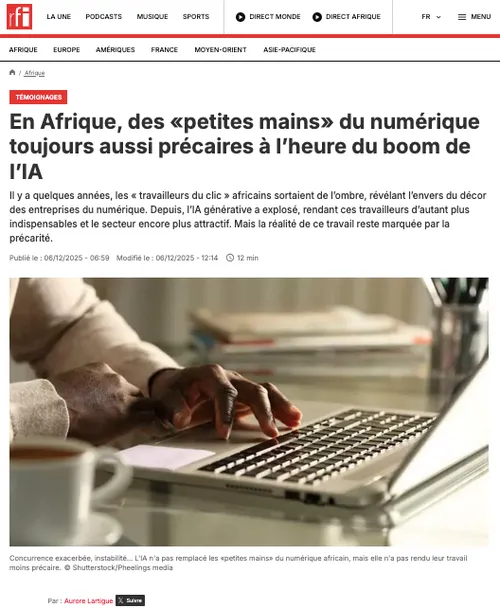
African Click Workers in the Age of Generative AI: Precarity Behind the Boom
DiPLab - Saturday, December 6, 2025In a recent article on Radio France Internationale (RFI), to which DiPLab’s co-founder Antonio Casilli contributed on behalf of the research group, readers encounter detailed testimonies from AI’s data workers across Kenya, Nigeria, Egypt, Togo, Uganda, Ghana, and South Africa who have performed data annotation and AI-training tasks for companies such as Outlier, Appen, and Mindrift. These stories confirm a structural reality: while generative AI has exploded, it has made AI’s hidden labor more indispensable than ever. Moreover, the working conditions behind the scenes remain precarious.

Workers describe how, after years of continuous tasks on online platforms, work has dried up, accounts have been abruptly closed, and only short, unstable tasks remain. Others relate juggling multiple platforms and projects (LLM evaluation, text and image annotation, audio labelling) because earnings from any single platform are not sufficient. Across the African continent, the boom in AI has not reduced human labor needs; on the contrary, as DiPLab’s data shows, the growth of generative systems requires more human re-training and fine-tuning, not less.
The testimonies gathered also echo the long history of “digital labor” in Africa: fragmented, piecemeal work distributed by global companies seeking inexpensive and highly flexible labor. The scandals surrounding Sama (a Kenyan company that moderated content for Meta and OpenAI before workers exposed traumatic working conditions) illustrate the human toll: exposure to extreme content, unstable contracts, and pressure to meet performance targets, sometimes for salaries that do not cover basic living expenses.
This pressure is also felt in creative domains. Designers and illustrators in African countries report collapsing compensation as generative tools flood the market, while their own creative output is used to train the models that now compete with them. As Casilli notes, creative professionals have been “pulled into the orbit of AI,” both feeding and being displaced by the same systems.
The article ultimately highlights a central contradiction of the AI industry: its glamorous narratives depend on a concealed workforce operating under poor conditions. Through ongoing documentation and research, DiPLab aims to ensure that these workers are not forgotten, and that the future of AI is built on fair and transparent labor practices, not disposable digital workers.